As the number of children in kinship care increase child welfare agencies are seeking policies,
programs and practice guidance to help develop and implement effective kinship care policies
and programs. Child welfare agencies are taking a new look at the nature of kinship care, the role
of kinship care as a child welfare service, and the relationship among kinship care family
preservation and out-of-home care. Many agencies are beginning to address a number of policy
and practice issues.
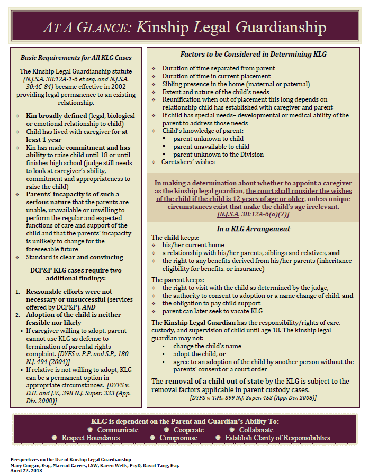
Kinship Legal Guardianship:
The kinship legal guardian is one who has made a commitment to and has the ability to raise the child to adulthood,
evidenced by the fact that the child has been in their home for a least one year. He/she can be a close family friend or
have a legal or biological relationship to the child. The kinship legal guardian assumes the same rights,
responsibilities and authority relating to the child as that of the parents, including the obligation to support the child.
Standby Guardianship
Raising Your Grandchildren, January 2010

Raising Your Grandchildren, January 2010
Kinship Legal Guardianship Pro Se Manual

Kinship Legal Guardianship Pro Se Manual
Is the child of a relative or close friend living in your home? Has the child been living with you for more than the last 12 months? Is this arrangement likely to continue? Do the parents have serious problems that prevent them from caring for their child? Are you willing to raise the child to adulthood? If you answered “yes” to these questions, then you may want to become the child’s kinship legal guardian. The Kinship Legal Guardianship law, which went into effect in January 2002, allows you — the caregiver — to become the child’s legal guardian. That means you act, in almost every way, like the child’s parent.
In Loving Arms

In Loving Arms
Most babies, children and youth have traumatic
experiences before going to live with their
grandparents, aunts, uncles or other relatives in
grandfamilies. More than half of children involved
with the child welfare system have experienced at
least four adverse childhood experiences (ACEs),
leaving them 12 times more likely to have negative
health outcomes than the general child population.
As the number of children in foster care increases,
due in part to the nation’s opioid crisis, the child
welfare system is increasingly relying on grandparents
and other relatives to raise the children. Yet grandparents
and other relatives are less likely than
non-related foster parents to receive supports
and services, including those provided by
professionals trained in helping children who
have experienced trauma.
Guide To Kinship Legal Guardianship Support Services

Guide To Kinship Legal Guardianship Support Services
Publication of New Jersey Department of Children and Families
Office of Adoption Operations Kinship Legal Guardianship Subsidy Program
The GrandKin Guide

The GrandKin Guide
Every year, more and more children in foster care find permanent homes with relatives when they cannot return to live with their parents. Most children will find permanent homes through relative adoption, which continued to increase throughout the decade. In 2000, 21 percent of the children adopted from foster care were adopted by relatives. By 2007, relative adoptions from foster care accounted for 28 percent of the children exiting foster care.
GrandFacts National Fact Sheets for Grandparents and Other Relatives Raising Children

GrandFacts National Fact Sheets for Grandparents and Other Relatives Raising Children
AARP, The Brookdale Foundation Group, Casey Family Programs, Child Welfare League of America, Children’s Defense Fund, and Generations United have partnered to produce state and national GrandFacts fact sheets for grandparents and other relatives raising children. The state fact sheets include state-specific data and programs as well as information about foster care, public benefits, educational assistance and state laws. Visit www.grandfactsheets.org to find this and all GrandFacts state fact sheets.
GrandFacts A State Fact Sheets for Grandparent and Other Relatives Raising Children

GrandFacts A State Fact Sheets for Grandparent and Other Relatives Raising Children
The data presented in these graphics is from the United States Census Bureau, the Annie E. Casey Foundation Kids Count Data Center and the Adoption and Foster Care Analysis Reporting System (AFCARS).
For more information on kinship care and caregivers, and for detailed instructions on accessing and interpreting this data, please visit: www.gu.org/resources/accessing-and-interpreting-grandfamilies-data/
- « Previous Page
- 1
- …
- 7
- 8
- 9
- 10
- 11
- …
- 327
- Next Page »